
How to Read a Women’s Probiotic Label: Strains, CFU and Blends
Check four things on a women’s probiotic label: strain IDs, a CFU count, any blends and the claims. Effects are strain-specific, and most products carry 1 to 10 billion CFU. FemiPro names five Lactobacillus strains with IDs but prints no CFU count, and its L. crispatus is not the strain used in trials.
What is on a women’s probiotic label?
A women’s probiotic label has five parts worth reading: the strain names, the CFU count, any blend, the claims and the other ingredients. Each one answers a different question about what you are paying for.
This post uses the FemiPro label as a worked example, gaps included. FemiPro is a bladder and urinary-support capsule with a probiotic blend, so it shows several common label choices at once.
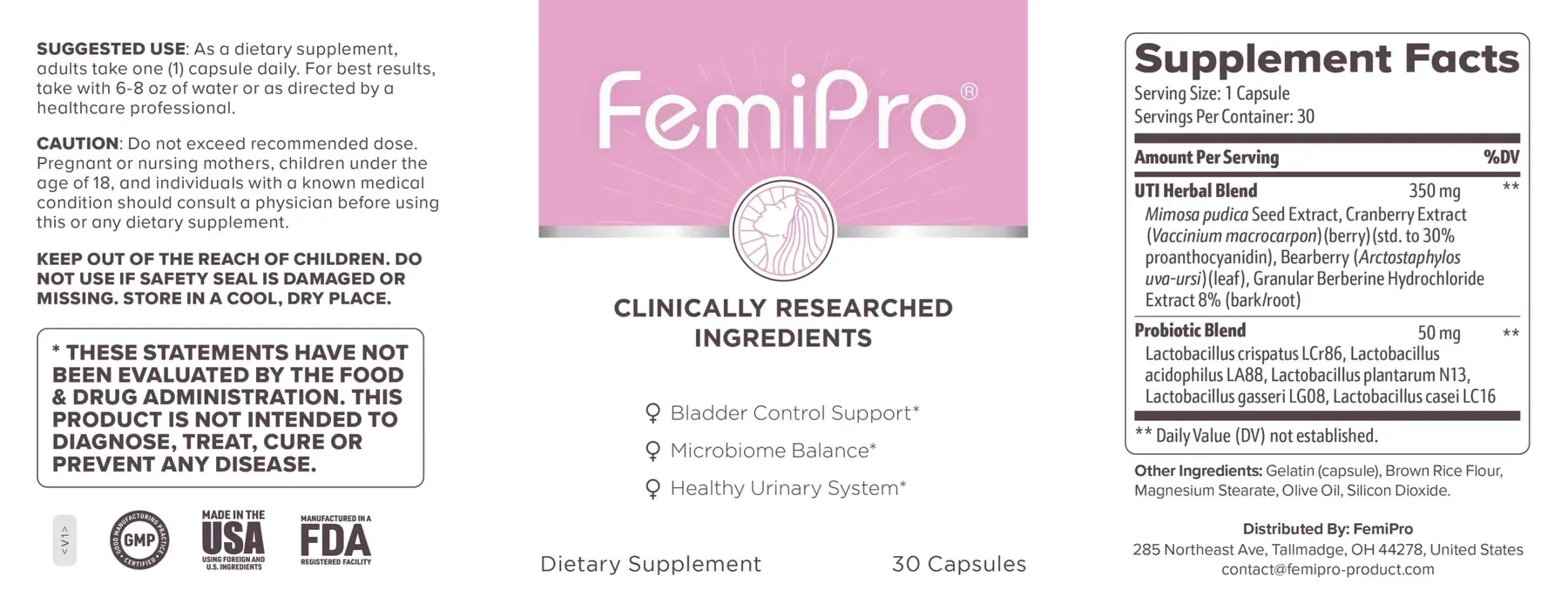
- Strains: which microbes, down to the strain ID
- CFU: how many live microbes per serving
- Blend: whether amounts are grouped under one weight
- Claims: what the maker says it supports
- Other ingredients: the capsule, fillers and storage advice
How do you read a probiotic strain name?
A full strain name has three parts: the genus, the species and a strain ID. The strain ID is the code after the species, and it is the part that links a product to research.
This matters because probiotic effects are strain-specific (NIH ODS, 2025). A study on one strain of L. crispatus does not prove anything about a different strain of the same species.
| Part | Example | What it tells you |
|---|---|---|
| Genus | Lactobacillus | The broad family of bacteria |
| Species | crispatus | The type within that family |
| Strain ID | LCr86 | The exact strain, which is what research is tied to |
The FemiPro label names all five strains with IDs. That is a good sign for label clarity. The seller’s listing graphic shows only two of them, L. crispatus and L. plantarum, so trust the label panel over the graphic.
What does CFU mean, and why does it matter?
CFU means colony-forming units, an estimate of how many live microbes are in each serving. The NIH Office of Dietary Supplements notes that most products carry 1 to 10 billion CFU (NIH ODS, 2025).
CFU is how probiotics are dosed in research. Without it, you cannot compare a product with a study.
Milligrams are not the same as CFU
A weight in milligrams tells you how heavy the powder is. It does not tell you how many live cells it holds. A probiotic powder can include carriers and dried culture material, so two blends of the same weight can hold very different counts.
Look also for when the count applies. Some labels give CFU at the time of making, and some give it through the best-by date. The later figure is the more useful one.
What is a proprietary blend on a supplement label?
A proprietary blend groups several ingredients under one total weight. The label lists what is inside but not how much of each one.
Blends are legal and common. The trade-off is that you cannot check any single ingredient against a research dose.
What you learn
The names of every ingredient and the total weight of the group.
What you lose
The amount of each ingredient, and so any dose check.
What to ask
Whether the maker will share the amounts or a CFU count.
FemiPro uses two blends. The 350 mg UTI Herbal Blend holds four herbs, and the 50 mg Probiotic Blend holds five strains. Our post on cranberry PACs shows how the herbal blend hides the cranberry dose.
Worked example: reading the FemiPro probiotic label

The FemiPro label scores well on strain names and poorly on dose. It names five Lactobacillus strains with IDs, but it gives only a 50 mg blend weight and no CFU count.
Here is the label, line by line, against what a clear probiotic label would show.
| Label item | What a clear label shows | FemiPro label | Verdict |
|---|---|---|---|
| Strain IDs | Genus, species and strain code | Five strains: L. crispatus LCr86, L. acidophilus LA88, L. plantarum N13, L. gasseri LG08, L. casei LC16 | Clear |
| CFU count | A number in billions per serving | Not printed | Missing |
| CFU timing | Count through the best-by date | Not printed | Missing |
| Amount per strain | Each strain listed on its own | One 50 mg blend | Hidden |
| Claims | Support claims with an asterisk | Bladder Control Support, Microbiome Balance, Healthy Urinary System | Standard |
| Capsule | Stated plainly | Gelatin, so not vegetarian | Clear |
| Storage | Clear storage advice | Store in a cool, dry place | Clear |
The missing CFU count is the biggest gap. It means the probiotic dose cannot be compared with the 1 to 10 billion CFU range most products carry.
Compare the FemiPro label with your own notes
Five named strains, a 50 mg blend and one capsule a day. Check the packs and the full label before you order.
Does the strain on the label match the research?
For FemiPro, it does not. The best-known L. crispatus trials used strain CTV-05 given vaginally, while FemiPro lists strain LCr86 in a capsule you swallow.
Both the strain and the route are different. So those trial results cannot be carried over to this product.
| Study | What was tested | Main result |
|---|---|---|
| Stapleton 2011 (Stapleton et al., 2011) | Vaginal L. crispatus CTV-05, 10 weeks, 100 women | Repeat UTIs 15% vs 27% on placebo; not statistically significant |
| Cohen 2020 (Cohen et al., 2020) | Vaginal L. crispatus CTV-05, 11 weeks, 228 women | Bacterial vaginosis came back less often, 30% vs 45% |
| Schwenger 2015 (Schwenger et al., 2015) | Probiotics for UTIs, 9 trials, 735 people | No significant drop in repeat UTIs vs placebo |
The honest summary is that oral probiotic evidence for UTIs is weak. The Cohen trial was about bacterial vaginosis, not the bladder, and it also used the vaginal route.
What do the claims and the asterisk on a label mean?
Claims such as “Microbiome Balance*” are structure/function claims. The FDA does not approve them before the product is sold, and the label must carry a disclaimer that says so (FDA, 2024).
The asterisk points to that disclaimer. It reads that the statements have not been evaluated by the FDA and that the product is not meant to diagnose, treat, cure or prevent any disease.
- Support words such as “supports” or “balance” are normal for supplements.
- Words such as “treats” or “cures” are drug claims and should raise a flag.
- A blend name is not a claim. The label’s “UTI Herbal Blend” is a name, not proof of an effect.
How do you check other ingredients and storage?
Read the other ingredients line for the capsule type and any fillers you want to avoid. Then read the storage line, since live bacteria are sensitive to heat and moisture.
The FemiPro label lists gelatin, brown rice flour, magnesium stearate, olive oil and silicon dioxide. It says to store the bottle in a cool, dry place. A vegetarian seal appears in some seller images, but the label lists gelatin, so the label wins.
The full panel is on the FemiPro Supplement Facts page, and the ingredients page explains each herb.
A quick checklist for any women’s probiotic label
Run through six checks before you buy. They take a minute and work on any brand.
Check the strain IDs
Every strain should have a code after the species name.
Find the CFU count
Look for a number in billions, ideally through the best-by date.
Spot the blends
Note which amounts are grouped under one weight.
Match the research
Check that the strain and the route match the study you read about.
Read the claims
Support claims are normal. Treatment claims are a red flag.
Check the capsule and storage
Confirm the capsule type and how to store the bottle.
Label checks are one part of the picture. Daily habits matter more for bladder control, as our post on bladder habits that help explains.
Probiotic labels: common questions
What does CFU mean on a probiotic label?
CFU stands for colony-forming units. It estimates how many live microbes a serving holds. Most probiotic products carry 1 to 10 billion CFU, according to the NIH Office of Dietary Supplements.
Why does the strain ID matter?
Probiotic effects are strain-specific. Two products can both list L. crispatus, yet use different strains with different research behind them.
How many CFU are in FemiPro?
The label does not say. It lists a 50 mg Probiotic Blend with five named Lactobacillus strains, but no CFU count.
Is the L. crispatus in FemiPro the one from the UTI trials?
No. The trials used L. crispatus CTV-05 given vaginally. FemiPro lists L. crispatus LCr86 in a capsule you swallow.
Do oral probiotics prevent UTIs?
The evidence is weak. A Cochrane review of 9 trials with 735 people found no significant drop in repeat UTIs compared with placebo.
What does the asterisk after a claim mean?
It points to the FDA statement. Claims about how a product supports the body are not reviewed by the FDA before sale, and the label must say so.
Is the FemiPro capsule vegetarian?
No. The label lists gelatin as the capsule material, so it is not vegetarian.